“The most repellent film I have seen this year. It contains all the impurities of the foulest human dross. It is sadism at its deepest level. It is the fleshpots of Pharaoh, modernized and filled to the overflowing. It is mental and physical putrefaction on the march but nearing the end of final decomposition.”
That was notorious Memphis film censor Lloyd Binford talking about Duel in the Sun. Binford was the head of the censor board in the Bluff City for 28 years. He decided what did and didn’t play on the big screen here, and Hollywood listened. He was an avowed white supremacist who once banned the 1947 Our Gang reboot Curley because it portrayed a mixed-race classroom. “During the mid- and late-1940s Binford particularly targeted any film that depicted social intermingling between races, no matter how innocent nor how mundane that interaction was,” says Steven J. Ross, professor emeritus at the University of Memphis. “Unless it unequivocally depicted Blacks as being subservient and deferential to white people, Binford either banned such films entirely or demanded the offending scenes be cut. Most famously, MGM relegated Lena Horne exclusively to song and dance numbers that could be removed from the film without affecting the story when it played in Memphis.”
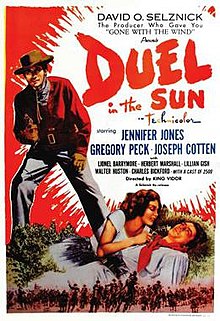
As you can see from the opening quote, another film Binford absolutely hated was Duel in the Sun. But it wasn’t a low-budget “race picture,” nor did it depict a train robbery (which was another sore spot with the unpredictable and grumpy censor). It was the second most popular film in America, written and produced by legendary Hollywood exec David O. Selznick, and cost more to make than Gone With The Wind. It starred A-listers Joseph Cotten, Gregory Peck, Lillian Gish, and Lionel Barrymore; star Jennifer Jones received an Academy Award nomination for her performance. And it was directed by King Vidor, the Texan who had put Memphis on the Hollywood map in 1929 with the all-Black musical Hallelujah.
No, Binford hated Duel in the Sun because it was just too sexy. “It is far from a great film,” Ross says. “But it absolutely was pushing the boundaries as to how far a prestige, big-budget film could depict sex and violence. Its nickname in the trade papers was ‘Lust in the Dust.’”

Ross has been studying Binford’s legacy as part of a new documentary project about the infamous censor with producers Barbara Hall and Tamara Trexler, and with Chris Blair, professor of media arts at Union University. “Binford made Memphis so notorious during his quarter-century reign as dead censor that the phrase ‘Banned in Memphis’ virtually became a nationwide advertising slogan to lure movie goers with the promise of something forbidden.”
Ross says Binford’s efforts to keep Memphians pure from the corrupting sights of cowpokes getting busy were all for naught, as moviegoers flocked across the bridge to West Memphis to see the picture. On August 26, Binford will again be thwarted when Ross hosts a screening of Duel in the Sun at Black Lodge, the Midtown movie Mecca that Ross calls “the perfect venue for films that are disreputable and yet full of astounding imagery. With Duel, we can laugh at its heaving-bosom, overheated sense of ‘forbidden sex’ while also appreciating the fever-dream quality of its lurid Technicolor images, which fortunately have been restored to all their original, over-the-top glory. If trash this be, it is trash made with the same skill, resources, imagination, and technical expertise seen in all the highly regarded Oscar-winning films that had made Selznick’s reputation as the most prestigious of all independent producers.”
Duel in the Sun rolls at 7 p.m. on Thursday, August 26; afterwards, Ross will lead a discussion of the deliciously trashy Western.